Despite Concerns, Island County And Oak Harbor Move Forward With Annexation
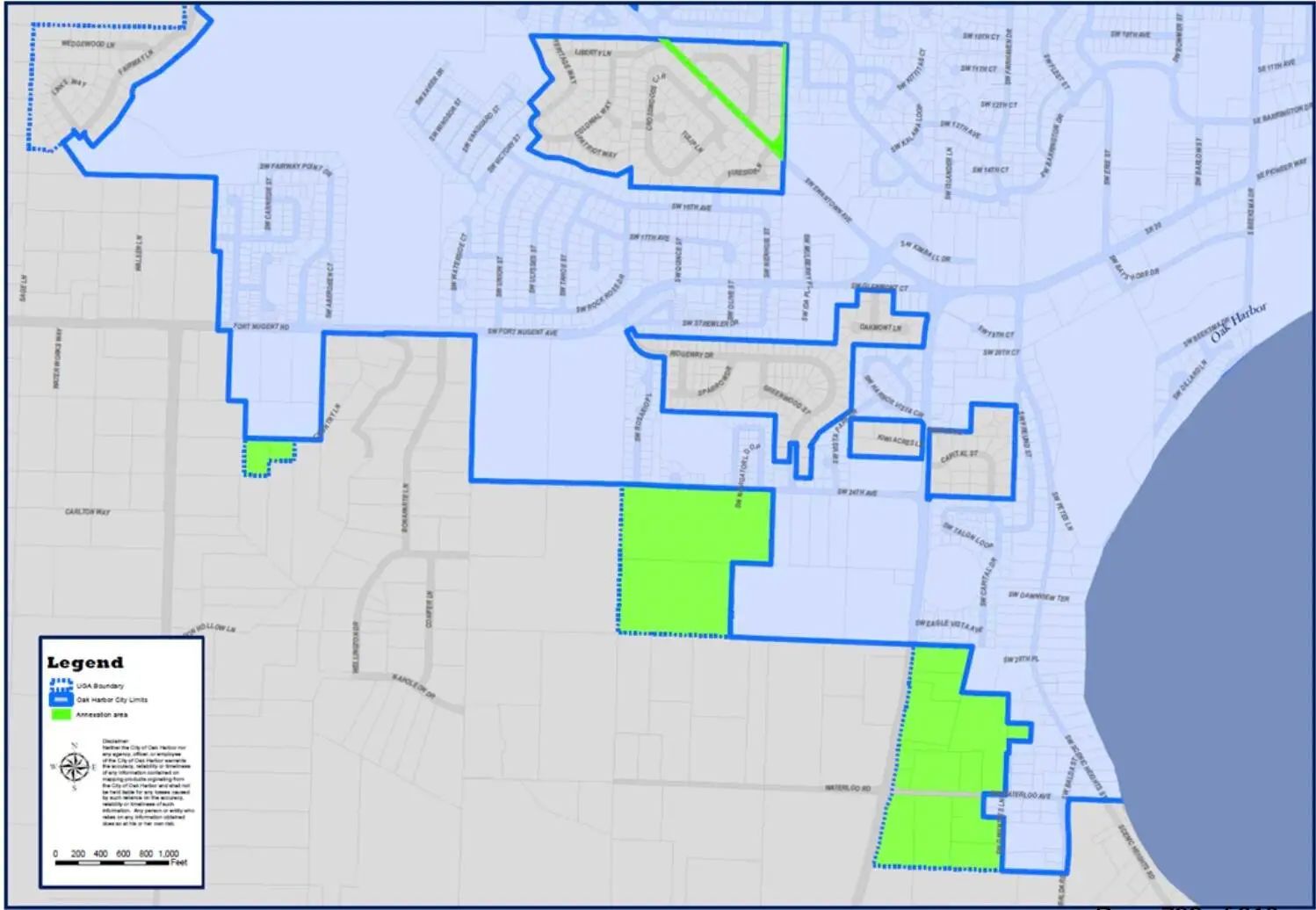
On March 19, 2026, the City of Oak Harbor and the Board of Island County Commissioners (BOCC) held a public hearing to discuss an interlocal agreement between the city and the county regarding the annexation of almost 80 acres currently within the Urban Growth Area (UGA) that Oak Harbor has identified as "vacant and underdeveloped" into the city limits. The City has requested annexation of this land to accommodate population growth outlined in the Island County Comprehensive Plan. Both jurisdictions are required to approve the interlocal agreement before continuing with annexation.
During public testimony, WEAN Executive Director Marnie Jackson urged Island County and the City of Oak Harbor to reconsider the terms of the proposed interlocal agreement before it is finalized and to follow the sequencing outlined by the Growth Management Act (GMA) by addressing current "donut holes," developed areas of unincorporated Island County surrounded by land incorporated into the City of Oak Harbor, before annexing any additional land. ("Donut holes" on the map above are represented in grey, surrounded by blue.)
"The GMA does not allow a city to manufacture a capacity shortage through declining to upzone and develop infrastructure appropriately, nor to allow that manufactured shortage to justify pushing growth into unincorporated land on the fringes of the city, furthest from urban services, and objectively less suitable for the denser, more affordable housing that the data shows we need," said Jackson.
State law, RCW 36.70A.110, directs that urban growth first be located in areas already characterized by urban development, rather than on land characterized as "vacant and undeveloped." Island County's own Comprehensive Plan, in accordance with that statute, directs urban development first to areas within municipal boundaries.
"Existing urban areas must be served and incorporated before or concurrent with new land being added at the fringe," stated Jackson. She also reminded both jurisdictions that Whidbey Environmental Action Network reserves the right to challenge this agreement before the Growth Management Hearings Board within the window following adoption, on the grounds that the jurisdictions did not follow the sequencing explicitly outlined by the GMA.
Rose Hughes, Managing Director of affordable housing developer Island Roots Housing, also gave public comment opposing the annexation proposal, arguing that it would put lower-income people on the fringes of the city, if affordable housing could be built in those areas at all. Hughes highlighted that the median hourly wage for working residents of Island County is $17.33, and that a significant portion of Island County workers earn less than 35% of the Area Median Income while working full-time. She also noted that the current proposal wouldn't create competitive conditions for affordable housing developers to receive the grant funding required to build in the annexed areas.
"If the purpose of this proposed annexation is for the farthest reaches of Oak Harbor to be the areas for higher density, low-income housing, you are literally saying that rather than accommodate rental housing within walking distance of where people work, you are going to put them on the edges of town and reserve the core of town for people who are not the residents, who are the backbone of the city's economic activity," said Hughes.
"I want to remind you that jurisdictions have a state-mandated obligation to provide equitable planning and housing opportunities for all income demographics across all areas of their jurisdiction," continued Hughes. "Is this annexation and zoning plan meeting these goals?"
Before public comment, Island County Planner Emily Neff assured the Board that the City and County have committed to working together through a separate interlocal agreement to address the "donut hole" areas that are surrounded by city land but not currently within city limits. The details of that separate agreement, or its current stage of development, were not shared by County staff during the meeting.
After brief deliberation, the City of Oak Harbor and the Board of Island County Commissioners both voted to approve the interlocal agreement as is, allowing the City of Oak Harbor to proceed with the annexation. The annexation process will occur at an upcoming Oak Harbor City Council Meeting, tentatively scheduled for April 7, 2026, at the time of the public hearing.
See the Oak Harbor City Council agenda center here.
Watch the public hearing here.