
When necessary, WEAN follows our advocacy with administrative appeals or court proceedings, holding jurisdictions and agencies to the laws that protect the environment and sometimes defending good decisions when others challenge them. Read about some of these cases below.
BREAKING NEWS—Court of Appeals Sides with WEAN: Oak Harbor Must Follow State Environmental Law Before Giving Away Park Land
On Monday, October 19, the Washington Court of Appeals, Division One, ruled in WEAN’s favor in Whidbey Environmental Action Network v. City of Oak Harbor, reversing the trial court’s dismissal of our lawsuit challenging Ordinance 1999.
Read more below.
Current Cases
| Case | Forum | Type | Status |
|---|---|---|---|
| Oak Harbor Parkland/Ord. 1999 | WA Court of Appeals | Court Appeal | Court of Appeals Rules for WEAN |
| Island County Comprehensive Plan | Growth Management Hearings Board | Administrative Appeal | Consolidated with two other appeals; schedule being finalized |
| Quade Creek area logging permit | Pollution Control Hearings Board | Administrative Appeal | Operations paused by agreement of parties; prehearing conference in October |
Historic Highlights

Photo by Timothy A. Gonsalves. Without WEAN's 1997 successful intervention, Island County would have allowed a 94% density increase on our shorelines, changing the character of our islands and destroying habitat forever.
| Year | Case | Forum | Outcome |
|---|---|---|---|
| 1998–2024 | Island County Comprehensive Plan | Growth Management Hearings Board | Ruled in WEAN's favor on about 80% of the issues in our appeal of the County's first Comprehensive Plan; the final issue was resolved in 2024 |
| 2022 | Navy training in state parks | Thurston County Superior Court | Ruled against the State Parks Commission's permit for covert Navy training; the Navy stopped the training and did not appeal |
| 2017 | Toads and prairie habitat | WA Court of Appeals | WEAN's victory led to meaningful protections for western toads and prairie habitat in Island County |
| 2011–2012 | Swantown Lake | Growth Management Hearings Board and Superior Court | Defeated Oak Harbor's attempt to expand its urban growth area into Swantown Lake |
| 2006 | Agricultural exemption | Growth Management Hearings Board | Ruled that the Growth Management Act does not allow Island County to exempt agricultural activities from its critical areas ordinance |
| 1997 | Shoreline zoning | Growth Management Hearings Board | Reduced coastal shoreline zoning from 3.5 units per acre to 1 unit per 5 acres |
| 1995 | Trillium wetland logging | Island County Hearing Examiner | Increased the fine against a Trillium Corporation forester who logged a protected wetland buffer tenfold, from $500 to $5,000, a decision that later helped protect 1.5 million acres in Patagonia |
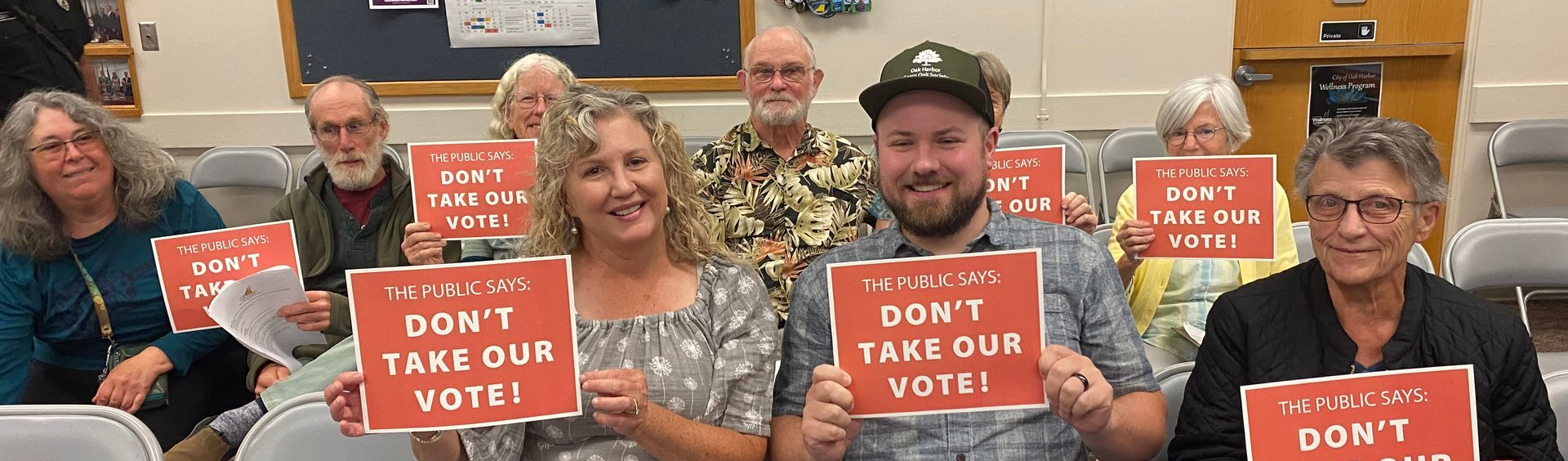
Photo by Amanda Bullis. The people of Oak Harbor resoundingly objected to Ordinance 1999, which changed their rights to vote on disposal of public park lands.
WEAN v. Oak Harbor: Ordinance Passage Without SEPA Process
MONDAY, OCTOBER 19, 2026: Court of Appeals Sides with WEAN: Oak Harbor Must Follow State Environmental Law Before Giving Away Park Land
On Monday, October 19, the Washington Court of Appeals, Division One, ruled in WEAN’s favor in Whidbey Environmental Action Network v. City of Oak Harbor, reversing the trial court’s dismissal of our lawsuit challenging Ordinance 1999.
Ordinance 1999 stripped away a long-standing protection for Oak Harbor residents: the requirement that the public approve, by vote, any sale of developed park property. The City passed it after a developer proposed a four-story hotel whose parking lot would take over part of Hal Ramaley Memorial Park. City staff openly acknowledged the ordinance was prompted by that hotel project, yet the City adopted it without review of its environmental consequences under the State Environmental Policy Act (SEPA).
The Court agreed with us on two key questions. First, it held that Ordinance 1999 is a “nonproject action” under SEPA. The City argued the ordinance was only about selling land, not using it—but the Court recognized that the ordinance ties the transfer of park property directly to development agreements, setting conditions that control how public parks may be used and changed. Second, the Court rejected the City’s claim that the ordinance was a merely “procedural” change exempt from review. Because it links park transfers to development, it is far more than procedural.
The Court also stressed a principle at the heart of SEPA: environmental review must happen at the earliest possible time, before a project gains momentum, not after. As our Supreme Court has said, SEPA is meant to shape our environment by deliberation, not default.
We were confident that state law was on our side, and we are grateful to the Court of Appeals for upholding the State Environmental Policy Act. The case now returns to the trial court for further proceedings. Because the City adopted Ordinance 1999 without the environmental review the law requires, we anticipate that the appropriate remedy will be vacatur of the ordinance—and we will continue working to ensure Oak Harbor residents have a voice before any of our parks are sold.
Thank you to every member and supporter who has stood with us.
We’ll keep you updated as the case moves forward.
___________
What Happened
On August 13, 2024, the Oak Harbor City Council voted to pass Ordinance 1999, which affects an election provision in the city code that previously granted citizens of Oak Harbor the right to vote whenever the City proposes to sell or transfer public park lands to a private entity.
What We Did
On August 30, 2024, WEAN filed a complaint against the City of Oak Harbor, asserting that the city failed to follow the State Environmental Policy Act (SEPA) when passing the ordinance as a non-project action. WEAN's initial filing also contended that the city council violated the Washington State Constitution. The complaint asked the court to vacate and reverse Ordinance 1999. Both parties requested a motion for summary judgment in the case, which was heard in Island County Superior Court on April 11, 2025. The Island County Superior Court granted Oak Harbor summary judgment, dismissing both of WEAN's complaints.
WEAN appealed this decision in the Washington State Court of Appeals. WEAN's appeal asserted that the Island County Superior Court erred in granting the City summary judgment and dismissing WEAN’s SEPA claim.
Why It Matters
It is necessary for Oak Harbor to assess the environmental impacts of the ordinance change on all parks within the City's limits and engage the community in the process of that assessment. If the city council is going to take away the voting provision within the ordinance — which would require the public to participate in every transfer of public parkland — the City must consider all of the environmental impacts of this ordinance amendment through a SEPA determination to properly assess how this change might impact the city's parks now and in the future.
WEAN v. City of Oak Harbor Legal Filings
List of Services
-
Appeals Court Ruling, Oct 19, 2026
The Washington Court of Appeals, Division One rules in WEAN’s favor in Whidbey Environmental Action Network v. City of Oak Harbor, reversing the trial court’s dismissal of our lawsuit challenging Ordinance 1999 and agreeing with WEAN on two key questions.
-
Appellant Response, Jan 20, 2026
WEAN's counsel reponds to the City, highlighting the ways in which the City's response distracts from the heart of the issue and paints a decidely false narrative of the facts of the case.
"The relevant question here is not whether the City can or cannot amend Ordinance 1110 as a general matter, but whether the new ordinance (Ordinance 1999) qualifies as a nonproject action under SEPA by amending or adopting standards that control the use or modification of the environment."
-
City Response To Appeal Brief, Dec 22, 2025
The City of Oak Harbor responds to WEAN's opening appeal brief, claiming that Ord. 1999 merely amends the process for transferring park land property and does not enact a regulation that controls the use or modification of the environment. The City claims the ordinance is categorically exempt from SEPA because it adopted purely procedural regulations and denies that the ordinance was changed to benefit development.
-
Court of Appeals Opening Brief, Oct 20, 2025
In this lawsuit and appeal, Whidbey Environmental Action Network (“WEAN”) argues that the City’s passage of Ordinance 1999 violates Washington’s State Environmental Policy Act (“SEPA”). With respect to SEPA, WEAN’s claim is that the City’s passage of Ordinance 1999 constitutes an “action” for which the City was required to evaluate potential adverse environmental impacts prior to adopting the challenged ordinance. The superior court erred in granting the City summary judgment and dismissing WEAN’s SEPA claim. WEAN now asks this Court to reverse.
-
Island County Superior Court Transcript Motion of Summary Judgement, April 11, 2025
Island County Superior Court granted Oak Harbor motion of summary judgement.
-
City Of Oak Harbor Answer And Affirmative Defenses, Sept 19, 2024List Item 2
The City admits that in 1997 the City of Oak Harbor chose to adopt a law that required citizen approval in an election for disposal of developed park land under certain circumstances. As to the remaining allegations or inferences contained in the Complaint, the City denies the same.
-
WEAN Complaint Against City of Oak Harbor, Aug 30, 2024List Item 1
On August 13, 2024, the Oak Harbor City Council voted against the will of the people to pass Ordinance 1999, which greatly impacts an election provision in the city code that previously gave the citizens of Oak Harbor the right to vote any time the City proposes to sell or transfer public park lands to a private entity. Ordinance 1999 took away this important right of the people, as an alleged “impediment” to a private developer’s proposal to pave over a significant portion of Hal Ramaley Memorial Park in downtown Oak Harbor, for use as a hotel parking lot. This lawsuit challenges the City’s passage of Ordinance 1999.

An Island County beach near Surfcrest, south of Deception Pass State Park. Inadequate planning for climate resilience, including for areas likely to experience tidal inundation and Sea Level Rise impacts, is among WEAN's critiques of Island County's Comprehensive Plan.
WEAN v. Island County: Comprehensive Plan Update
What Happened
On June 23, 2026, Island County adopted its periodic update to the Comprehensive Plan under Washington's Growth Management Act (GMA), along with related changes to the County Code (Ordinances C-34-26 and C-35-26). These documents shape where and how growth happens on Whidbey and Camano Islands for the next 20 years.
What We Did
WEAN spent several years engaging deeply the County's planning process, submitting roughly 800 pages of comments. WEAN also formed a consortium with Island Roots Housing and Agricultural Resources Committee of Island County, together securing Climate Commitment Act funding from the State Department of Commerce to bring environmental, housing, and farming concerns together around the Comprehensive Planning table. WEAN commends our partners in that effort and the planning team for moving many aspects of the plan forward since the previous adoption. Nonetheless, we believe there are areas in which it does not yet meet the standards set by state law.
On August 28, 2026, represented by Telegin Law, WEAN filed a Petition for Review with the Growth Management Hearings Board. We argue that the plan and code changes fall short of the GMA in several ways:
Rural sprawl and farmland. New rural cluster rules allow development beyond rural densities. They also extend that clustering into the County's Commercial Agriculture zone, the only farmland the County has designated for long-term protection.
Septic and sewer capacity. The plan increases housing densities in the Freeland Non-Municipal Urban Growth Area (NMUGA) and in some rural areas (Limited Areas of More Intensive Rural Development, or LAMIRDs) without adequate septic or sewer capacity, and without funded plans to provide that capacity. This is internally inconsistent.
Growth in the wrong places. The County reduced the growth allocated to Oak Harbor without adequate evidence and agreed to the annexation by the City of greenfield land prior to the annexation of urbanized, under-served "doughnut holes" completely surrounded by the City. That plans for urban growth out of sequence.
Climate resilience. The new Climate Element defers identifying climate impacts and adaptation measures to future, unfunded planning.
Critical areas, salmon, and shorelines. The plan does not rely on best available science to protect critical areas, and it does not give the special consideration to salmon habitat that state law requires.
We are asking the Board to send the plan back to the County for corrections. We are also asking it to declare the new rural cluster rules invalid while that work happens.
The Board has consolidated WEAN's appeal with two others, filed by Citizens of the Ebey's Reserve for a Healthy, Safe, and Peaceful Environment and by Cornerstone Homes LLC. The schedule is being finalized, and we expect to share more in early 2027.
Why It Matters
The Comprehensive Plan is the blueprint for Island County's future. If it pushes growth into rural areas without water, septic, and road capacity, the costs fall on farmland, groundwater, streams, and the salmon that depend on them, and they are very hard to reverse. The GMA exists to direct growth into cities and towns where services exist, and to protect rural character and resource lands.
WEAN v. Island County Legal Filings

Photo by Joe Menth, taken from a property adjoining the forested wetland parcels approved by the DNR for clearcutting.
WEAN v. Washington State Department of Natural Resources: Quade Creek Area Logging Permit
What Happened: On August 19, 2026, the Department of Natural Resources (DNR) approved a forest practices permit for a clearcut of about 37 acres on South Whidbey. The permit also allows about 2,400 feet of new road and new culverts on steep, wet ground above the Quade Creek watershed. Quade Creek feeds Maxwelton Creek, one of the island's most important salmon streams. DNR approved the permit two days before its own posted public comment deadline, and without considering WEAN's timely comments.
What We Did
WEAN commented on this proposal twice, in July and August 2026. On August 27, 2026, WEAN appealed DNR's approval to the Pollution Control Hearings Board and asked for a stay of logging while the appeal is decided. More than a dozen WEAN members and neighbors submitted sworn declarations in support. We argue that:
- DNR decided before its own public comment period closed.
- DNR's own screening flagged high slope-stability risk, so the permit should have received full environmental review (Class IV-Special under SEPA). It was instead approved as a routine Class III permit.
- The application contains numerous internal contradictions about road lengths, culvert sizes, wetland impacts, and acreage.
- DNR approved it before the wetland and stream surveys its own review team had called for were completed.
- Stream protections were set without first determining how far upstream salmon habitat extends, as a rule adopted in March 2026 requires.
All parties have agreed to a stay, so
no logging will occur while our formal motion for a stay is pending. A prehearing conference on our appeal is set for October 5, 2026.
Why It Matters
Communities in the Maxwelton watershed have spent some 30 years building toward the possibility of salmon returning. South Whidbey students release salmon fry at the Maxwelton Outdoor Classroom nearby, where sedimentation from this project could significantly reduce water quality. Clearcutting and road building on steep, saturated slopes risks sending sediment into fish-bearing streams, overwhelming culverts under public roads, and cutting off the only access roads for neighboring households. Accurate mapping and wetland typing are essential when these kinds of conditions are present, and state law requires DNR to look closely at these risks before approving a permit like this. We are asking the Board to make sure that happens.
WEAN v. DNR Legal Filings
List of Services
-
WEAN's Notice of Appeal
Read WEAN's Notice of Appeal, which was served on the Washington State Attorney General, Washington State Department of Natural Resources, and the Landowners. The logging company has also intervened.
-
WEAN's Motion for Stay
WEAN moved for a stay of operations. A negotiation among parties yielded a voluntary agreement to pause onsite activity until the Hearings Board rules on this motion.

In the News: Current Cases
Island County Comprehensive Plan
- Two appeals target Island County comp plan. South Whidbey Record, Sept. 1, 2026.
Quade Creek logging permit
- Opponents challenge DNR logging approval on South Whidbey. South Whidbey Record, Aug. 28, 2026.
- Proposed logging near South Whidbey salmon stream raises alarm. South Whidbey Record, July 24, 2026.
Oak Harbor Ordinance 1999
- State Court of Appeals hears WEAN v. Oak Harbor. Whidbey News-Times, April 24, 2026
- Park ordinance appeal to be heard in Oak Harbor. Whidbey News-Times, April 7, 2026
- Judge grants city's motion for summary judgment in litigation over Oak Harbor parkland code. Whidbey News-Times, April 15, 2025
- City, WEAN ask for summary judgment in park lawsuit. Whidbey News-Times, March 4, 2025.
Environmentalists sue Oak Harbor over ordinance. South Whidbey Record, Sept. 6, 2024
Past victories
- WEAN wins anti-war award. Whidbey News-Times, Sept. 23, 2022.
- Arguments set for WEAN's lawsuit over Navy training at parks. Whidbey News-Times, April 5, 2022
- WEAN isn't suing county for first time in 25 years. Whidbey News-Times, Jan. 18, 2022.
- Group sues over Navy training in state parks. Whidbey News-Times, March 9, 2021
- Whidbey group declares court victory over prolific logger. Everett Herald, Feb. 13, 2019
- Logger, county, WEAN in another legal showdown. Whidbey News-Times, April 23, 2019
More news
- Three decades of advocacy: WEAN has made its mark on environmental policy in Island County. South Whidbey Record, Aug. 13, 2019
- WEAN hires director, plans to extend reach. South Whidbey Record, March 22, 2023
- WEAN's engagement director heads to law school. South Whidbey Record, May 26, 2026
- Whidbey's grassroots success story: Celebrating the 25th anniversary of no-spray movement. South Whidbey Record, Sept. 12, 2025
- Survey responses shape Comprehensive Plan update. South Whidbey Record, Feb. 25, 2025
- Environmental group seeks community input. South Whidbey Record, Jan. 24, 2025
- Whidbey activists propose change to county forest code. South Whidbey Record, Dec. 24, 2024
- Whidbey environmentalists push for state agency to codify fish net-pen ban. South Whidbey Record, Dec. 3, 2024