BOCC Votes To Adopt Comprehensive Plan At June 23 Meeting

At the June 23 meeting of the Board of Island County Commissioners, the latest published version of the Comprehensive Plan and the corresponding Development Code were approved by the Board as presented by the Island County Planning Department in compliance with Washington state’s Growth Management Act (GMA). The moratorium on development in Limited Areas of More Intensive Rural Development (LAMIRDs) was lifted as a result. What is the Comprehensive Plan? Click here.
The purpose of the day’s hearing was to determine if the presented Plan and Code would be adopted by the Board of Island County Commissioners in a process that’s been underway for the past three years, or if substantive changes were needed before adoption. The latter would trigger another public notice process and a continuation of planning.
Here’s what happened in the lead-up: Before the 10am start, the room and Zoom were packed with members of the public, including WEAN staff and members, interested in both the Comprehensive Plan hearing and other agenda items. The Commissioners announced that regular public comment would be moved to the end of the meeting—an atypical move contrary to published Island County procedure.
Key Changes
When it came time, Assistant Director of Long Range Planning, Emily Neff, started the Comprehensive Plan hearing by presenting key changes to the Plan as compared to 2016. These included Natural Resources element updates, with increased measures to protect water quality in aquifers from risk of development, No Net Loss (NNL) requirements, and additional policies to support sustainable forest management.
Included in the key changes presentation was also the issue of
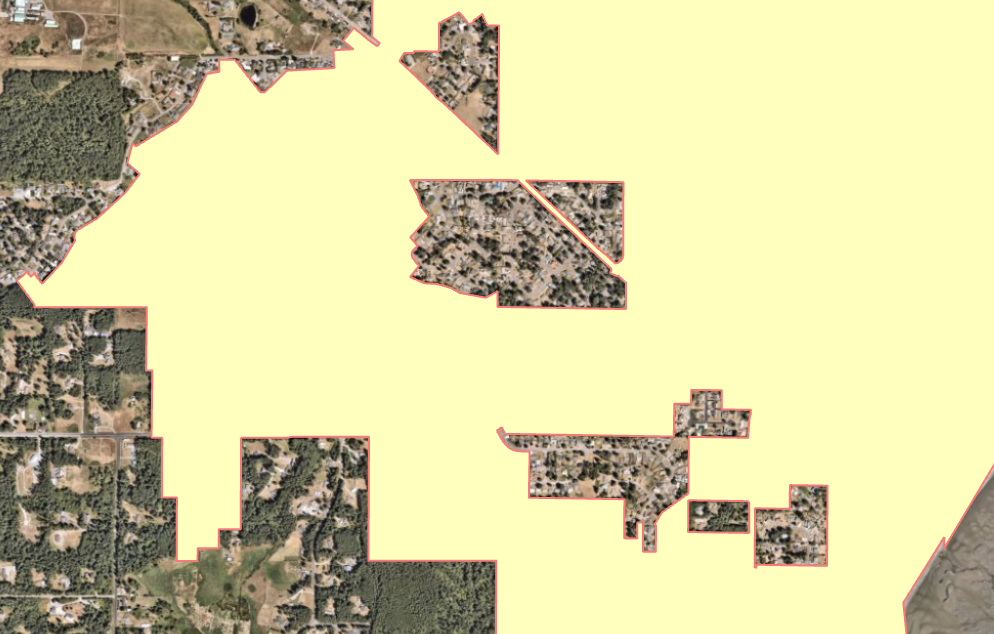
Oak Harbor’s land annexation and changes to its city boundary (i.e. annexing land on its outskirts prior to annexing four unincorporated, urban-style “donut holes” surrounded by city land).
Next, Neff presented code updates. Of particular interest to WEAN (which partnered with affordable housing developers
Island Roots Housing to propose language for areas of the Plan where the Housing element intersects with rural areas), the Plan zones for more density in the Limited Areas of More Intensive Rural Development (LAMIRDs). It also adopts a Rural Cluster code that groups more dense home developments in the rural area and requires water system, setback, and buffer standards in exchange for a density bonus. The Rural Cluster code is modeled after an older Planned Residential Development (PRD) code which WEAN fought to constrain to legal standards in the previous iterations of the Comprehensive Plan.
Public Comments
Everyone who gave public comment acknowledged the hard work of putting together the Plan and thanked those involved. However, remaining issues were voiced, including by District 1 Island County Planning Commissioner and board member of Island Roots Housing, Michael Clyburn. He expressed that the county had not shown a compelling need for Rural Clusters, which largely fail to meet the need for affordable housing and instead serve an income bracket for which there is abundant capacity without this change. WEAN co-founder Steve Erickson also spoke to Rural Clusters and said that if the provision is written without any safeguards or limits on market-rate clusters, it’s a violation of the GMA. WEAN Executive Director Marnie Jackson echoed Clyburn’s concern that market-rate Rural Clusters neither solve a stated need, nor protect Island County’s land and communities and that the plan for market-rate Rural Clusters has the potential to illegally fragment rural land.
Jackson continued by reiterating that the county’s agreement to Oak Harbor’s annexation of greenfield land on its outskirts before urban-style unincorporated “donut holes” are addressed is inconsistent with the GMA. Addressing necessary density in the Freeland Non-Municiple UGA and LAMIRDs like Bayview and Clinton, Jackson commented that the Plan is required to account for 20 years of population growth, along with housing growth, but that this draft acknowledges that septic capacity is insufficient. She asserted that this goes against the standards required by law. She stated that Freeland’s sewer dilemma has already been studied, and the Plan's funded six-year Capital Improvement Plan (CIP) must move beyond studies into implementation of necessary wastewater infrastructure. WEAN member and former Island County Planning Commissioner Dean Enell encouraged the county to check out the
sewer system in Jefferson County’s Port Hadlock, which had a defunct NMUGA, but is now seen as an example of GMA-compliant achievement.
Comments also focused on critical areas and preserves. WEAN member and engaged community member
Carlos Andersen asked that the word “Preserve” be added to places where it was missing from “Deer Lagoon” in the Comprehensive Plan to avoid misinformation (i.e. not a recreation space, but a protected space, in alignment with a grant agreement to which the county is bound). He also pointed out a map with erroneous water access points in Deer Lagoon Preserve, with two points needing deletion in order to avoid causing adverse environmental impacts through would-be beach-goers trampling sensitive nest sites. Jackson also expressed concern at not seeing changes in this draft from the previous version despite Commissioners’ directive to staff to include language regarding the need for case-by-case stewardship planning for preserves. She added a concern with the decision to ignore meaningful mapping errors, including at Deer Lagoon Preserve. She said she would also like to see a more proactive approach to sea level rise adaptation in coastal ecosystems and communities in future versions of the plan.
WEAN Engagement Director, Amanda Bullis, commented that while she appreciated several appropriate places where No Net Loss was included, the definition of NNL in the glossary still only references shorelines and not all the critical areas explicitly protected by the GMA. She asked to expand the definition to that standard. Additionally, she asked the Board to consider the lack of mitigation planning in the Plan, noting a
technical report that WEAN recently published.
Jackson and Bullis said they hoped for an iterative planning process. Jackson also added a hope for annual updates to better include and represent Island County’s community needs and perspectives, as many of these issues continue to evolve.
Final Deliberations
When it came time to deliberate, Commissioner St. Clair said she was not interested in substantive change but was interested in an iterative process.
Commissioner Johnson asked if changing maps was a substantial change. Neff answered that yes it was substantive. Commissioner Johnson replied she wasn’t currently concerned about the maps as there are plans to continue with Parks and Transportation elements, including mitigation as it pertains to Transportation, in 2027. Neff clarified for Commissioner Johnson that the county is required to update its critical areas ordinance, which more or less implements the Natural Resources element, and that ordinance is due by the end of the year. Commissioner Bacon asked if that would address the NNL issues and Neff responded that it could include NNL.
Commissioner St. Clair then referenced Bullis’ comment about the Revised Code of Washington (RCW) NNL definition only referring to shorelines and noted it comes directly from the state, but that it didn’t imply the definition can’t be expanded to non-shoreline critical areas in the future. Commissioner Johnson asked if changing the NNL glossary definition was a substantive change and Neff replied that staff decided not to change the definition, but that the definition could be discussed at the future critical areas ordinance update.
Commissioner Johnson moved on to Oak Harbor saying there is not an economic pathway forward for residents in the donut holes. She said the planned economic development studies of these areas will be good to have, as well as studies around the economic development of open space and natural resources. She went on to say that a sewer in Freeland is theoretically easy, but it is unique and that Clinton may have easier options than Holmes Harbor, but that there is commitment to find a solution.
Commissioner Johnson also asked to clarify if the prohibition in LAMIRDs on storage or marijuana facilities includes large-scale parking lots. The response was that you can’t do major capital facilities in those areas and that parking for things like mixed use buildings would be allowed, but that sole, large-scale parking lots were not.
Commissioner Bacon expressed that the Plan largely reflects the wishes of the voters of Island County, but that there are some hanging issues, such as with Deer Lagoon Preserve. She noted these would be dealt with when the Parks element is reopened; that Natural Resources issues would be addressed during future discussions of the critical areas code; and that there would be opportunity for further conversations about Rural Clusters. With that, the Plan and Codes were passed unanimously.
What's Next?
From July 1, 2026, WEAN will have 60 days (ending on August 31, 2026) to file an appeal. Without such a petition, the Comprehensive Plan Update will go into effect following the 60-day appeal period. Timely appeals will need to be reviewed by the Growth Management Hearings Board, pausing the Plan going into effect until the issuance of the Board's final order. WEAN asserts that some of the content in the Plan does not yet comply with state law, and further communications on the subject of a potential appeal will be forthcoming.
Note that the
public engagement website will be decommissioned on July 6, 2026. For latest news on the Plan, go
here.
Thanks to everyone who submitted written and/or oral comments throughout this process. Your continued civic engagement strengthens our Island County community.